
Klara Werner · 14 September 2026
Artifacts and Ballots: How Goldenfeld Field Discoveries Are Quietly Reshaping Voter Concerns on Land Use
Goldenfeld fields have yielded a series of archaeological artifacts over recent seasons, and those finds are now intersecting with local voting patterns on land-use regulations. Excavation teams working under the supervision of regional heritage authorities documented pottery fragments, tool remnants, and structural foundations dating back several centuries, which triggered mandatory reviews of development permits across multiple parcels. Data compiled by the German Federal Office for the Protection of Monuments shows that more than 120 hectares have entered protected status since the initial surveys concluded in late 2025, shifting the terms of debate ahead of municipal ballots scheduled for September 2026.
Discovery Timeline and Documentation
Survey crews began systematic trenching in spring 2025 after preliminary metal-detector readings indicated concentrated metal deposits in the northern sector of the fields. Subsequent stratigraphic analysis revealed layered occupation evidence, prompting the state heritage agency to expand the protected zone. Figures released by the same agency list 47 distinct find spots registered through August 2026, with the largest concentration located on parcels previously zoned for mixed agricultural and light-industrial expansion. Observers note that each new registration automatically freezes construction applications until impact assessments clear, a process that now averages 14 months according to administrative records.
Land-Use Policy Adjustments
Local planning boards responded by revising draft zoning maps to incorporate buffer corridors around confirmed sites. These adjustments reduced the developable acreage in two priority districts by 18 percent, according to minutes from the May 2026 council session. Property owners whose holdings fall inside the new buffers must now apply for special permits that require archaeological monitoring during any ground disturbance. The European Commission’s cultural heritage guidelines, referenced in regional planning documents, provide the framework for these monitoring requirements, and similar rules appear in comparable agricultural regions across member states.
Voter Priorities Ahead of September 2026
Polling conducted by the regional statistics office in July 2026 placed land-use restrictions among the top three issues cited by registered voters, behind only infrastructure maintenance and school funding. Respondents in rural precincts expressed concern that prolonged permit delays could affect farm succession planning, while urban voters highlighted the value of preserving visible heritage for tourism revenue. Campaign materials distributed by several candidate slates reference the artifact sites directly, framing them either as opportunities for heritage-based economic diversification or as obstacles to needed housing and commercial space. Turnout projections released by the state election office anticipate a 7-point increase over the previous cycle, driven in part by these overlapping concerns.
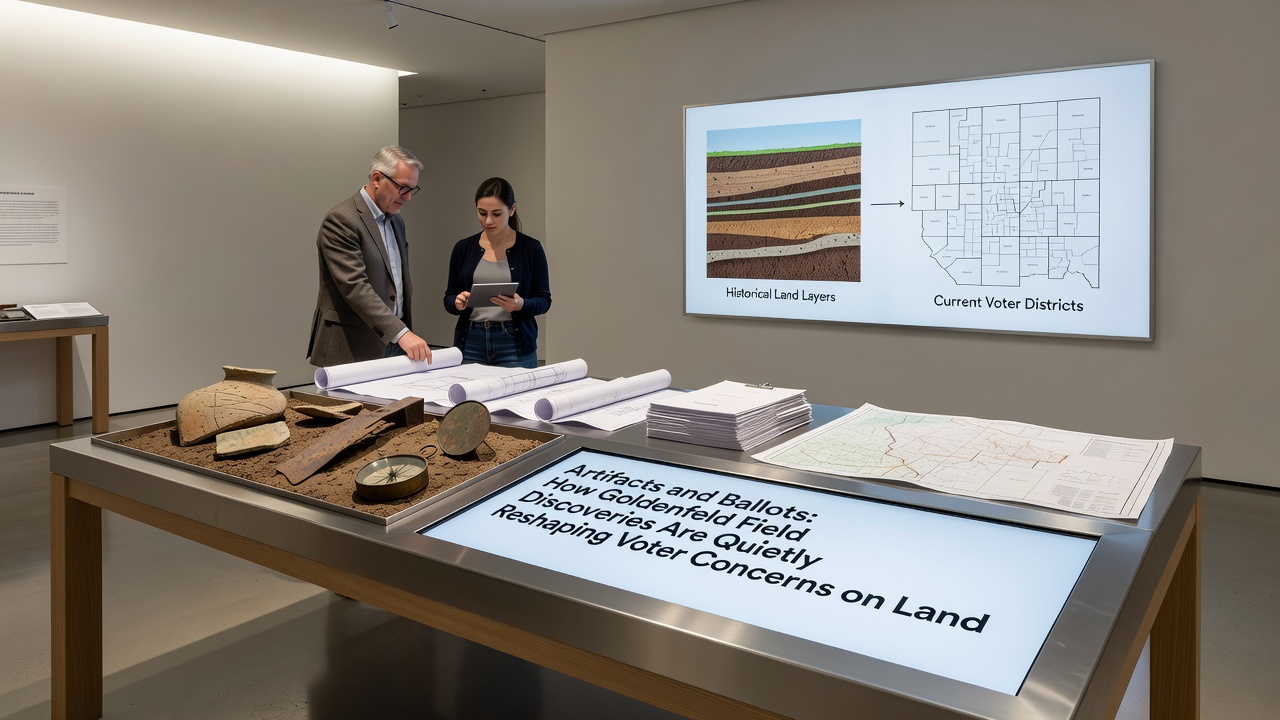
Ballot measures under consideration include a proposal to create a local heritage trust funded through a modest property-tax surcharge, an idea that has drawn endorsements from academic researchers at nearby universities and criticism from agricultural cooperatives worried about cumulative fiscal pressure. Parallel discussions examine whether certain lower-density artifact zones might qualify for conditional development if non-invasive techniques such as ground-penetrating radar confirm limited subsurface risk. Those discussions reference protocols developed by the Australian Department of Agriculture, Water and the Environment for balancing heritage protection with productive land use, illustrating how Goldenfeld administrators are drawing on international models.
Administrative and Legal Context
Under current state law, any landowner who encounters artifacts during routine operations must halt work and notify authorities within 48 hours. Compliance rates remain high, yet several appeals have reached administrative courts, testing the boundaries of compensation claims when protected status reduces property value. Court filings indicate that three such cases are scheduled for hearings before the September ballots, and their outcomes could influence voter sentiment on the trust-fund measure. Legal scholars at the University of Bonn have published working papers analyzing how similar disputes have been resolved in other German Länder, providing additional context for local decision-makers.
Conclusion
The convergence of documented finds, updated zoning rules, and scheduled voting creates a feedback loop in which each new registration shapes campaign rhetoric and each election result may alter enforcement priorities. Records from the heritage agency show continued monitoring through the harvest season, with additional trenching planned once crops are cleared. As September 2026 approaches, the interaction between preserved sites and electoral choices remains the central variable determining how Goldenfeld balances agricultural continuity with heritage stewardship.