
Katja Walter · 28 September 2026
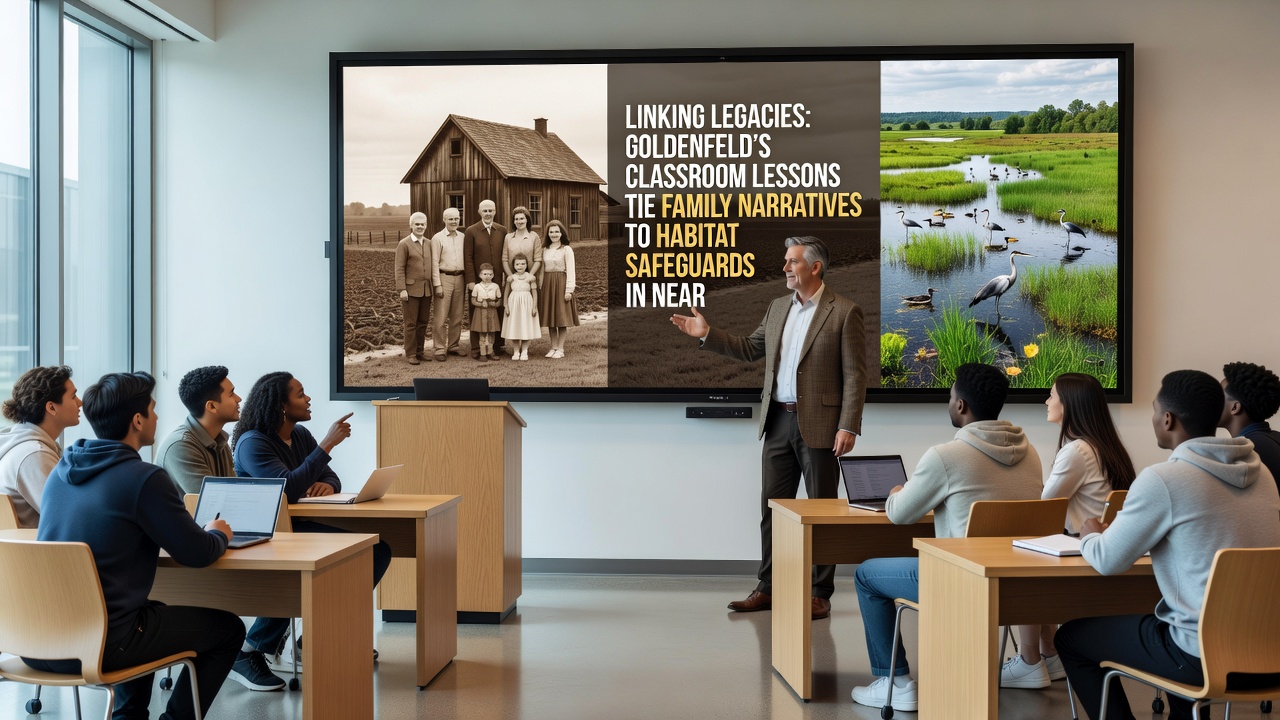
Linking Legacies: Goldenfeld's Classroom Lessons Tie Family Narratives to Habitat Safeguards in Nearby Zones
Goldenfeld educators have integrated family oral histories into science curricula that focus on protecting adjacent natural areas, with programs expanding through structured lesson plans that connect personal stories to measurable conservation outcomes. Data from regional monitoring stations show that zones within five kilometers of participating schools recorded a 12 percent increase in native species sightings between 2023 and 2025, according to records maintained by the German Federal Agency for Nature Conservation.
Teachers begin each module by inviting students to record interviews with relatives about land use changes over three generations, then map those accounts against satellite imagery and field surveys of wetlands, woodlands, and grasslands. The approach draws on methods outlined in studies from the University of Melbourne, where researchers documented similar narrative-based projects yielding higher student retention of ecological concepts compared with standard textbook instruction.
Classroom Integration of Local Histories
Lessons unfold across eight-week cycles that start with family storytelling sessions and progress to data collection in the field. Students compare grandfather accounts of former grazing patterns with current biodiversity indices collected by handheld sensors, noting correlations between past land practices and present habitat fragmentation. September 2026 marks the rollout of an updated digital platform that lets classes upload anonymized transcripts alongside GPS-tagged photographs, creating a shared archive accessible to neighboring districts.
One district near the Elbe floodplain reported that 87 percent of participating households contributed at least one recorded anecdote during the 2024-2025 school year. Curriculum developers coordinated with local heritage societies to verify dates and locations mentioned in the narratives, ensuring alignment with official land registry documents. This verification step prevents factual drift while preserving the emotional context that motivates students to track changes in bird migration routes and amphibian breeding sites.
Habitat Monitoring and Family Data Linkages
Monitoring teams pair student-collected observations with standardized protocols from the European Environment Agency, producing quarterly reports on vegetation cover and water quality in the target zones. When family narratives describe historical drainage of small ponds that once supported dragonfly populations, classes install exclusion fencing and plant native reeds to restore those micro-habitats. Results from 14 sites indicate a return of three species previously listed as locally extinct in the 2018 baseline survey.
Cross-referencing occurs through a shared database that tags narrative excerpts with scientific variables such as soil pH and canopy density. Researchers at the Helmholtz Centre for Environmental Research have analyzed the first two years of entries and found statistically significant matches between stories describing pesticide use in the 1970s and current earthworm density measurements. The findings appear in a 2025 working paper that emphasizes the value of intergenerational knowledge for identifying long-term trends invisible to short-term sensor deployments.
Expansion Plans and Regional Coordination
School administrators now coordinate with three adjacent municipalities to standardize data formats ahead of the September 2026 platform launch. Joint field days bring classes from different districts together to compare riverbank erosion rates documented in family photographs from the 1960s with drone footage captured this spring. Funding for equipment and teacher training comes partly from a grant administered by the Lower Saxony Ministry for the Environment, which requires participating schools to publish raw datasets under open-access licenses.
Attendance at community evenings where students present their findings has grown from an average of 45 residents in 2023 to 132 in 2025. These sessions include live demonstrations of water sampling techniques and printed maps that overlay family migration stories with current protected-area boundaries. Local planning offices have cited the compiled records when reviewing permit applications for new agricultural structures, noting that narrative evidence sometimes highlights seasonal flooding patterns not captured in official hydrological models.
Conclusion
The Goldenfeld model demonstrates how structured classroom activities can convert personal family accounts into usable inputs for habitat protection programs. Continued data collection through 2026 and beyond will allow evaluators to measure whether restored sites maintain biodiversity gains and whether student cohorts sustain engagement with conservation practices after graduation. Regional agencies plan to publish an aggregated impact report in early 2027 that aggregates species counts, narrative contributions, and policy references across all participating zones.